SNOWTAM Explained: A Complete Guide for Aviation Professionals and Enthusiasts
In aviation, runway conditions are directly tied to flight safety. When runways are contaminated by snow, ice, slush, or water, aircraft braking performance can change significantly. To ensure this critical information is shared clearly and consistently, the aviation industry uses SNOWTAM.
1. What is SNOWTAM?
SNOWTAM (Snow Notice to Airmen) is a standardized report that provides information about runway surface conditions, especially when they are affected by contaminants such as:
- Snow
- Ice
- Slush
- Standing water
It allows pilots, dispatchers, and air traffic controllers to assess braking action and aircraft performance before takeoff and landing.
2. Why SNOWTAM is Important
Runway contamination can:
- Reduce braking effectiveness
- Increase landing distance
- Affect directional control
SNOWTAM ensures that all stakeholders receive accurate, real-time, and standardized data, which is essential for safe decision-making.
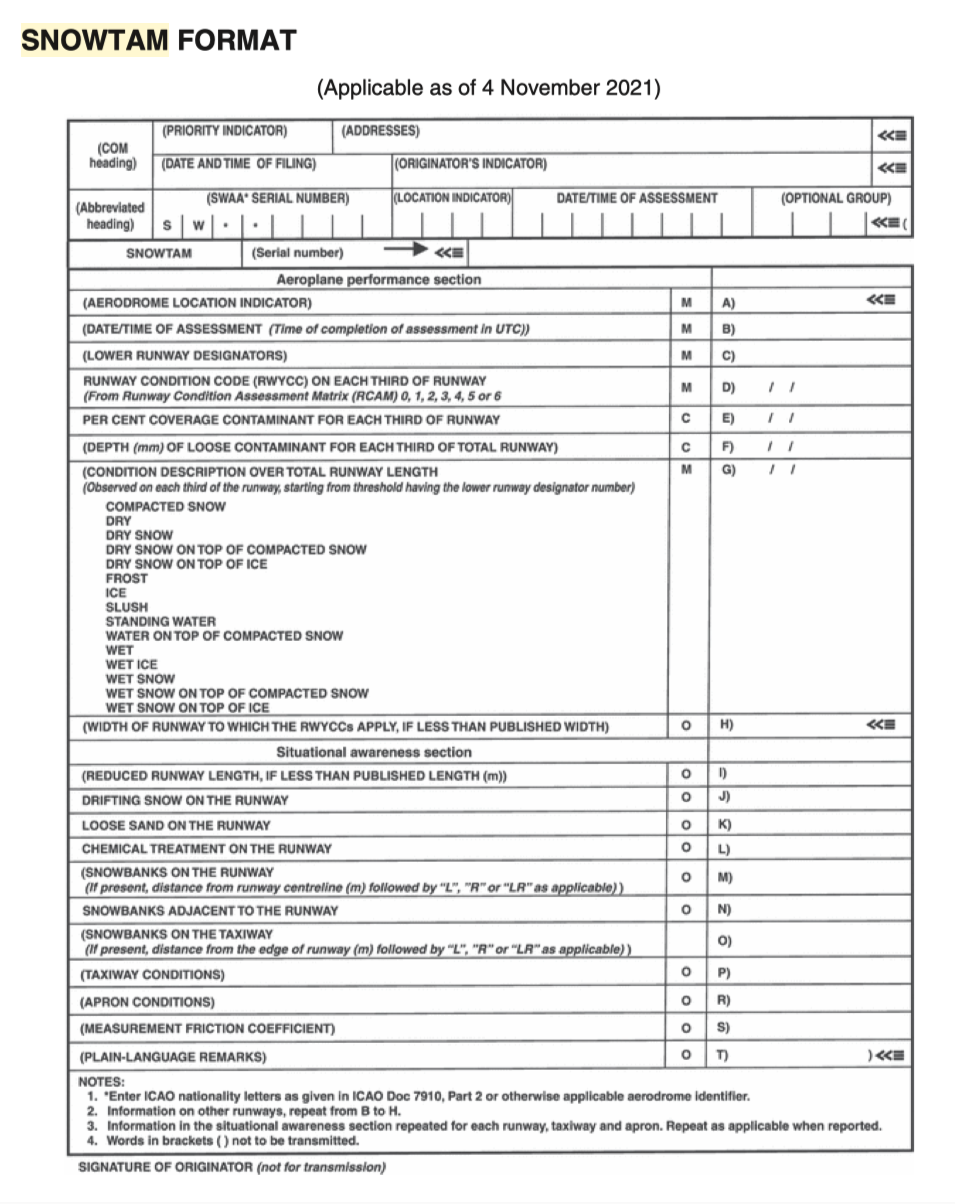
3. SNOWTAM Format Overview (ICAO 2021 Standard)
Since November 2021, SNOWTAM follows a structured format defined by the ICAO (International Civil Aviation Organization). The format is divided into key sections:
✈️ A. Aeroplane Performance Section (Mandatory)
This section directly impacts aircraft performance calculations.
- A) Aerodrome Location Indicator
ICAO airport code (e.g., RKSI) - B) Date/Time of Assessment (UTC)
Time when runway condition was evaluated - C) Runway Designator
Runway identification (e.g., 15L, 33R) - D) RWYCC (Runway Condition Code)
Values from 0 to 6, based on braking performance
(0 = very poor, 6 = dry) - E) Percent Coverage of Contaminant
How much of each runway third is contaminated - F) Depth of Contaminant (mm)
Thickness of snow/slush/water - G) Description of Surface Condition
Examples:- Dry snow
- Wet ice
- Slush
- Standing water
🧭 B. Situational Awareness Section (Optional)
Provides additional operational context.
- H) Runway Width Reduction
- I) Reduced Runway Length
- J) Drifting Snow
- K) Loose Sand
- L) Chemical Treatment
- M–O) Snowbanks (Runway/Taxiway)
- P) Taxiway Conditions
- R) Apron Conditions
- S) Friction Measurement (if available)
- T) Plain Language Remarks
4. Understanding RWYCC (Runway Condition Code)
RWYCC is one of the most critical elements in SNOWTAM.
CodeBraking ActionDescription
| 6 | Good | Dry runway |
| 5 | Good | Wet runway |
| 4 | Medium to Good | Compact snow |
| 3 | Medium | Slippery conditions |
| 2 | Medium to Poor | Reduced braking |
| 1 | Poor | Very slippery |
| 0 | Less than Poor | Extremely hazardous |
Each runway is divided into three sections, and each section gets its own RWYCC.
5. Example SNOWTAM Interpretation
A typical SNOWTAM might indicate:
- RWYCC: 5/5/3
- Contamination: Wet snow on final third
- Depth: 3 mm
👉 This means:
- First two-thirds: Good braking
- Last third: Reduced braking performance
Pilots will use this to adjust landing distance and braking strategy.
6. Key Takeaways
- SNOWTAM is essential for safe winter operations
- It provides standardized runway condition reporting
- RWYCC is the most critical factor for performance calculations
- Always check the latest SNOWTAM before departure and arrival
Conclusion
SNOWTAM plays a vital role in aviation safety, especially during adverse weather conditions. Understanding how to read and interpret it is not just for pilots—it’s valuable knowledge for anyone involved in aviation operations.
As global standards continue to evolve, the 2021 ICAO SNOWTAM format ensures better clarity, consistency, and safety across the industry.
'KNOWLEDGE' 카테고리의 다른 글
| AIR-GROUND COMMUNICATIONS FAILURE - doc 4444 (0) | 2026.10.08 |
|---|---|
| MEA/MOCA/MORA/GRID-MORA symbols in Jeppesen Enroute chart (0) | 2026.05.03 |
| The Influence of V₁ on Accelerate-Go and Accelerate-Stop Distances (0) | 2025.10.20 |
| How to Find Official Aeronautical Charts for Vietnam (AIP & Airport Charts) (0) | 2025.08.07 |
| WAKE TURBULENCE SEPARATION (Time based and Distance based) (0) | 2025.07.02 |


