Disclaimer:
▪︎This content is Not an official document and does not represent the views of Airbus or any other aviation authority.
▪︎The information provided may be incorrect or misinterpreted and should not be relied upon for decision-making.
▪︎Always refer to official documents and consult with a qualified aviation professional before making any decisions based on the information provided in this blog post.
▪︎The information provided in this blog post is based on personal study and review.
A320 aircraft with center tank pumps and those with center transfer (XFR) valves, based on your FCOM and MEL sources :
🔧
System Description Differences
FeatureA320 with Center Tank PumpsA320 with Center Transfer Valves
| Fuel Feed Method | Two electric pumps (CTR TK PUMP 1 and 2) deliver pressurized fuel from the center tank to the engine feed lines. | Two transfer valves (CTR TK L/R XFR) open to let fuel gravity-feed from the center tank into the wing tanks. |
| Control | Controlled automatically via the MODE SEL pb-switch in AUTO, or manually via individual pump switches. | Controlled automatically in AUTO mode; valves open when wing tank quantity drops below ~5,000 kg, and close when center tank is empty. Manual control possible via L/R XFR pb-switches. |
| Feed Path | Pumps supply fuel directly to the feed manifold (and thus engines). | Fuel must first transfer into the wing inner tanks before being fed by wing pumps to the engines. |
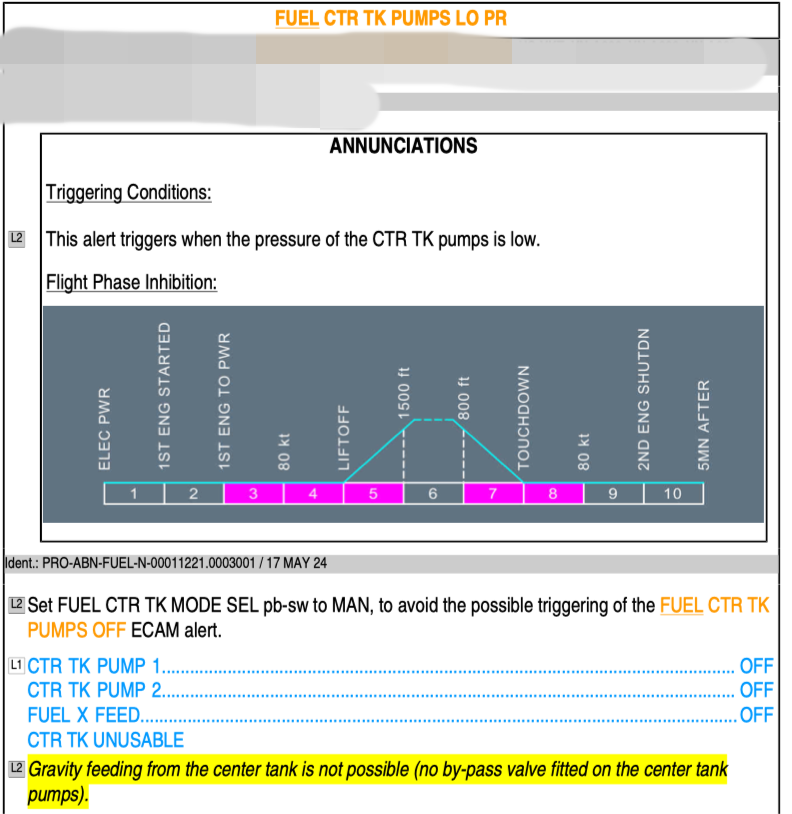
| Failure Indications | ECAM message: FUEL CTR TK PUMP LO PR. | ECAM message: FUEL CTR L(R) XFR FAULT. |
✅
Advantages
A320 with Center Tank Pumps
- Provides positive fuel pressure to the engines, ensuring reliable feed even in high-altitude or negative-G conditions.
- Faster center tank emptying; suitable for shorter sectors needing quick CG change.
- Simpler fuel monitoring logic in older configurations.
A320 with Center Transfer Valves
- Lower system complexity: no electric pumps, less maintenance.
- Reduced electrical load and improved reliability (fewer moving parts).
- Lower risk of fuel leaks or electrical arcing in the tank.
- Safer in case of pump-related fuel vapor ignition scenarios.
- Better suited for sharklet-equipped or newer A320 models optimized for fuel efficiency.
❌
Disadvantages
A320 with Center Tank Pumps
- Higher maintenance and inspection requirements for electric pumps and wiring.
- Possible wing tank overflow on ground due to IDG fuel recirculation if pumps run after slat extension .
- Pump failure may leave residual unusable fuel in center tank (MEL restriction).
A320 with Center Transfer Valves
- Slower transfer since it relies on gravity differential, not pump pressure.
- Fuel cannot feed engines directly—requires wing tanks to receive it first.
- Limited ability to use fuel in abnormal attitudes or high climb angles.
- In case of both valve failures closed, center tank fuel becomes unusable .

⚙️
Operational Considerations
- Center Tank Pump Aircraft:
- Center Transfer Valve Aircraft:
- Valves automatically open when wing tanks < 5,000 kg and close when CTR tank empty. Manual control is available if AUTO mode fails.
🧭
Summary
CategoryCenter Tank PumpCenter Transfer Valve
| Reliability | More components → more potential failures | Simpler, more reliable |
| Maintenance | Higher | Lower |
| Weight | Slightly heavier | Slightly lighter |
| Fuel Transfer Rate | Faster | Slower (gravity-fed) |
| Safety | Potential pump sparking risk | Lower electrical risk |
| System Type | Older A320s | Newer A320s / A320neo-style updates |
https://320study.tistory.com/19
CTR TK XFR vs CTR TK PUMP
Disclaimer: ▪︎This content is Not an official document and does not represent the views of Airbus or any other aviation authority. ▪︎The information provided may be incorrect or misinterpreted and should not be relied upon for decision-making. ▪
320study.tistory.com
'SYSTEM' 카테고리의 다른 글
| Gravity Fuel Feeding (0) | 2025.10.02 |
|---|---|
| PACK REGULATOR FAULT MEL (0) | 2024.07.10 |
| Ground Speed Mini (2) | 2024.06.27 |
| Understand the FMA at all times (0) | 2024.05.27 |
| ALL WHITE LIGHTS OFF (3) | 2024.02.29 |


